
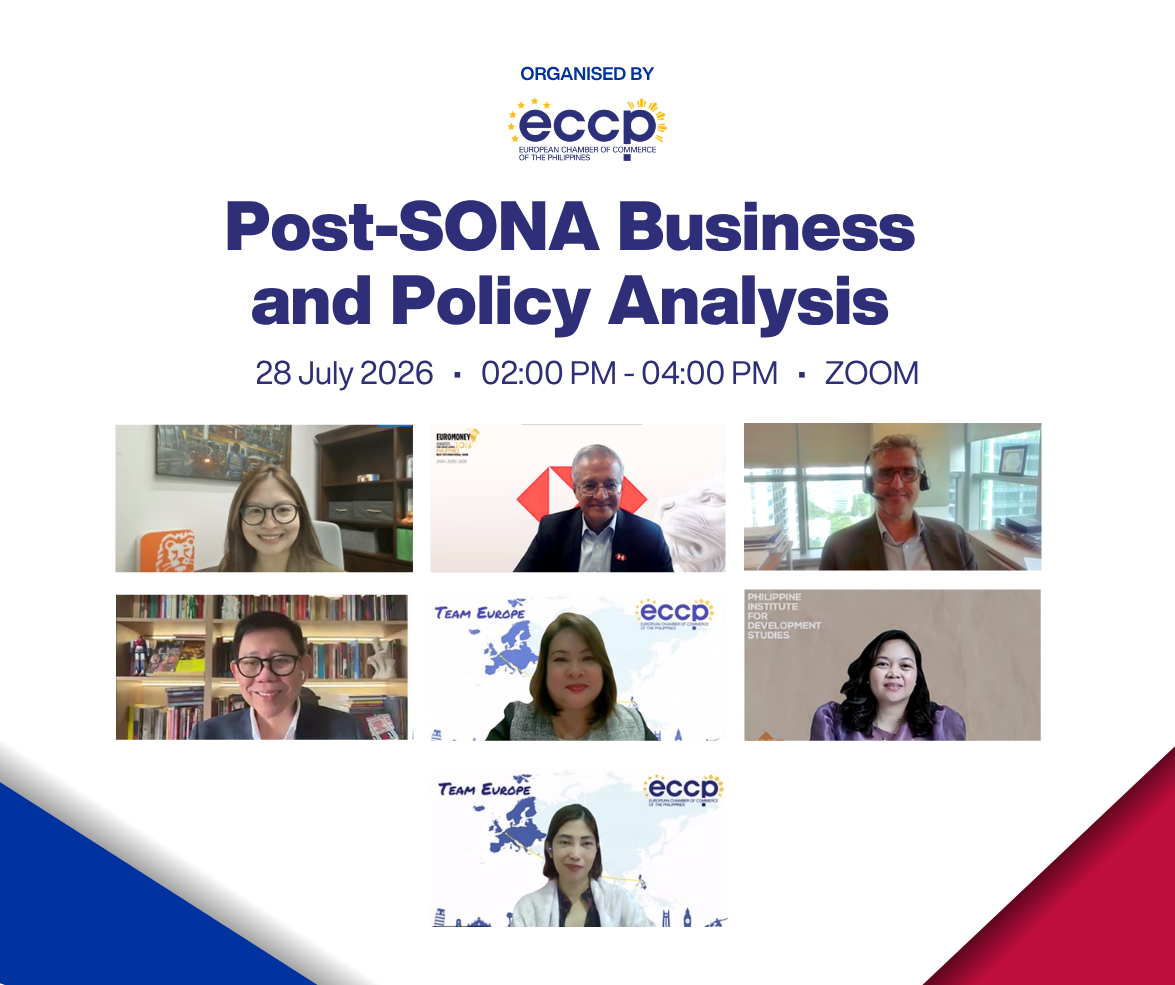
(Top Row, L–R): Atty. Maria Concepcion Simundac-Delos Santos, Mr. Sandeep Uppal, Dr. Gonzalo Varela. (Middle Row, L–R): Dr. Julio C. Teehankee, Dr. Diana Edralin, Ms. Mary Grace Agner. (Bottom Row): Atty. Kathyrin Pioquinto.
MAKATI CITY, Philippines — The Philippines’ dependence on imported food and fertiliser means that a rise in global oil prices could quickly develop into a food-price shock for households and businesses, HSBC Philippines President and CEO Sandeep Uppal said during the European Chamber of Commerce of the Philippines’ post-SONA policy briefing.
Uppal explained that rising geopolitical risks can reach the domestic economy through the exchange rate, energy costs, transport, and agricultural inputs. He also stressed that investment incentives alone will not be enough to attract and retain long-term capital.
“Capital follows predictability, credibility, and capability,” he said, pointing to rules-based investment policies, a credible reform narrative, and reliable public infrastructure as key considerations for investors,” Uppal remarks.
Across the discussion, speakers agreed that the success of the administration’s policy agenda will depend on whether reforms are implemented consistently, supported by capable institutions, and translated into stronger firms, higher-quality investments, and better jobs.
The forum, “ECCP Post-SONA Business and Policy Analysis 2026: From SONA to Strategy,” brought together diplomats, business executives, financial institutions, economists, and policy experts to assess the political, economic, and commercial implications of President Ferdinand R. Marcos Jr.’s fifth State of the Nation Address.
SONA as a policy signal
Opening the session, ECCP President and Roche Philippines General Manager Dr. Diana Edralin said the SONA should be viewed not only as a political address, but also as an important signal of government priorities.
“The President’s annual SONA is more than a political speech. It is a policy signal. The question is not only what reforms were announced, but which are politically feasible, institutionally actionable, and commercially meaningful,” Dr. Edralin said.
She added that the ongoing EU-Philippines Free Trade Agreement negotiations present an opportunity to deepen cooperation in energy, healthcare, technology, infrastructure, and regional value chains.
Reform feasibility and the cost of delay
Dr. Julio C. Teehankee of De La Salle University examined what may be politically and institutionally achievable before 2028. He noted that political timing, legislative priorities, institutional capacity, and the presence of credible reform champions will influence which measures can advance during the administration’s remaining years.
World Bank Lead Economist Gonzalo Varela highlighted the rising cost of delaying productivity reforms amid slower growth, weaker investment, and renewed inflationary pressure.
He stressed that the next phase of development should focus on creating more and better jobs by enabling firms to start faster, scale predictably, trade reliably, and upgrade continuously.
Varela also highlighted the gap between the quality of the country’s regulatory framework and its implementation. He noted that free trade agreements can serve as platforms for productivity and growth, but only when businesses can use them through efficient customs processes, lower trade costs, reliable logistics, and predictable regulation.
Investment resilience and readiness
Uppal’s presentation showed how external shocks can move quickly through oil prices, the peso, fertiliser costs, transport, and food prices. The Philippines’ reliance on imported food and agricultural inputs makes the economy particularly exposed to these pressures.
Mary Grace Agner of the Philippine Institute for Development Studies discussed the uneven performance of the manufacturing sector amid geopolitical tensions, elevated domestic prices, weather-related disruptions, skills gaps, and limited access to finance and technology.
She emphasised that investment promotion must be matched by investment readiness. This includes stronger workforce development, digital infrastructure, efficient and transparent public spending, wider access to finance, and well-designed public-private partnerships.
The panel, moderated by Atty. Maria Concepcion Simundac-Delos Santos, Chair of the ECCP Tax and Financial Services Committee, also examined how domestic reforms can prepare Philippine firms and supply chains for deeper economic integration under a prospective EU-Philippines FTA.
Closing the forum, ECCP Director for Advocacy and Government Affairs Atty. Kathyrin Pioquinto said: “The Philippines must sequence reforms carefully, but implement them with urgency. It must manage external shocks while building stronger domestic capabilities. And it must move beyond attracting investment to creating an environment where firms can enter, grow, innovate, trade, and create better jobs.”
She added that an FTA can expand market access, but its benefits will depend on whether customs systems work, regulations are predictable, infrastructure is reliable, and firms have the capacity to compete and scale.
ECCP reaffirmed its commitment to work with government agencies, Congress, the Joint Foreign Chambers, and private-sector partners to translate policy direction into practical and measurable outcomes.


Serving the European-Philippine business community since 1978, the ECCP remains committed to enabling cross-sector collaboration, promoting economic growth, and championing a sustainable future. For inquiries or further information, you may contact us directly or connect with us through our official social media channels.