
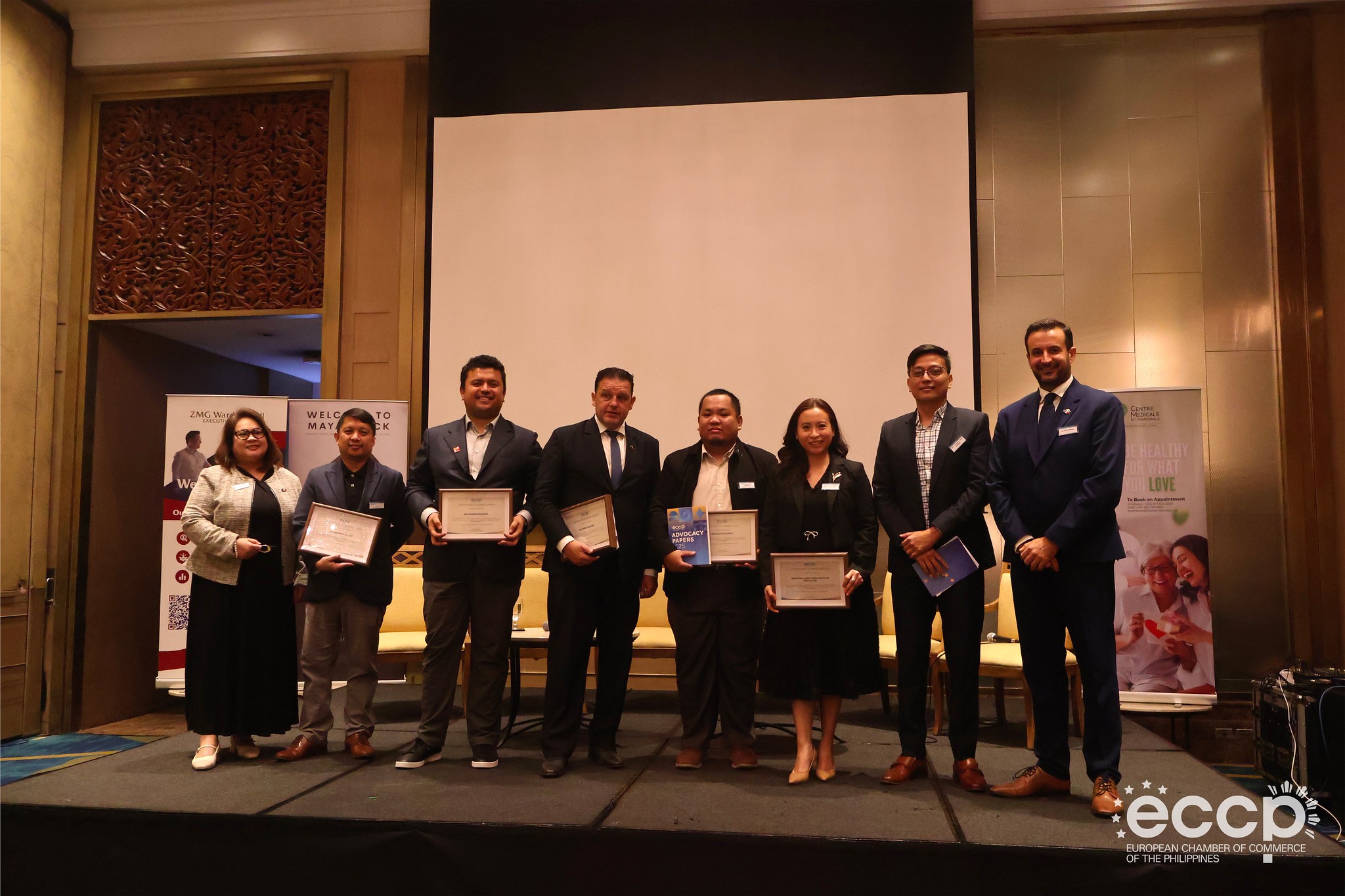
Government, industry, and development leaders call for a human-centered approach to AI readiness across the Filipino workforce
MAKATI CITY, Philippines — Artificial intelligence is already reshaping how Filipinos work. The harder question is who gets to shape what comes next.
That was the throughline of the European Chamber of Commerce of the Philippines’ (ECCP) 2026 Future of Work Forum, convened by its Human Capital Committee on 06 August 2026 at Dusit Thani Manila.
Under the theme “People, Policy, and Progress: Advancing Workforce Excellence in the Era of Artificial Intelligence,” government leaders, private sector executives, and development partners agreed on one point above all: the future of work will not be decided by technology alone, but by how well institutions invest in people.
“The future of work demands collaboration across sectors,” said Mr. Albert Perez, ECCP Treasurer and Human Capital Committee Co-Chair, in his opening remarks. “It requires government creating an enabling policy environment, educational institutions preparing learners for emerging industries, businesses investing in continuous learning, and international partners sharing global best practices and innovative solutions.”
From AI users to AI builders
The Philippines has no shortage of AI adoption. The challenge is building AI capability.
Dr. Marco Gemmer, Head of Cooperation at the Delegation of the European Union to the Philippines, opened the forum by underscoring the value of EU-Philippines cooperation on AI governance and workforce readiness.
Hon. Galo B. Glino III, Deputy Director General of the Technical Education and Skills Development Authority (TESDA), reframed AI as a call for “all in” cooperation across government, industry, education, and workers. He outlined TESDA’s goal of equipping one million Filipino workers with AI skills through micro-credentials, enterprise-based training, and online learning.
TESDA also highlighted its PHP 641 million allocation to support 35,000 learners in AI and data skills training, as well as around 90,000 enrollments in AI-related online courses as of July 2026.
Mr. Sherwin Pelayo, Executive Director of the Analytics and Artificial Intelligence Association of the Philippines, presented the National AI Upskilling Roadmap, a public-private initiative to build AI literacy and a stronger national talent pipeline. His diagnosis: 95 percent of Philippine organizations are already using AI, but only 12 percent are building homegrown AI capability. The real gap, he said, is not adoption but readiness. The roadmap, he added, is how the country moves from being an AI user to an AI builder.
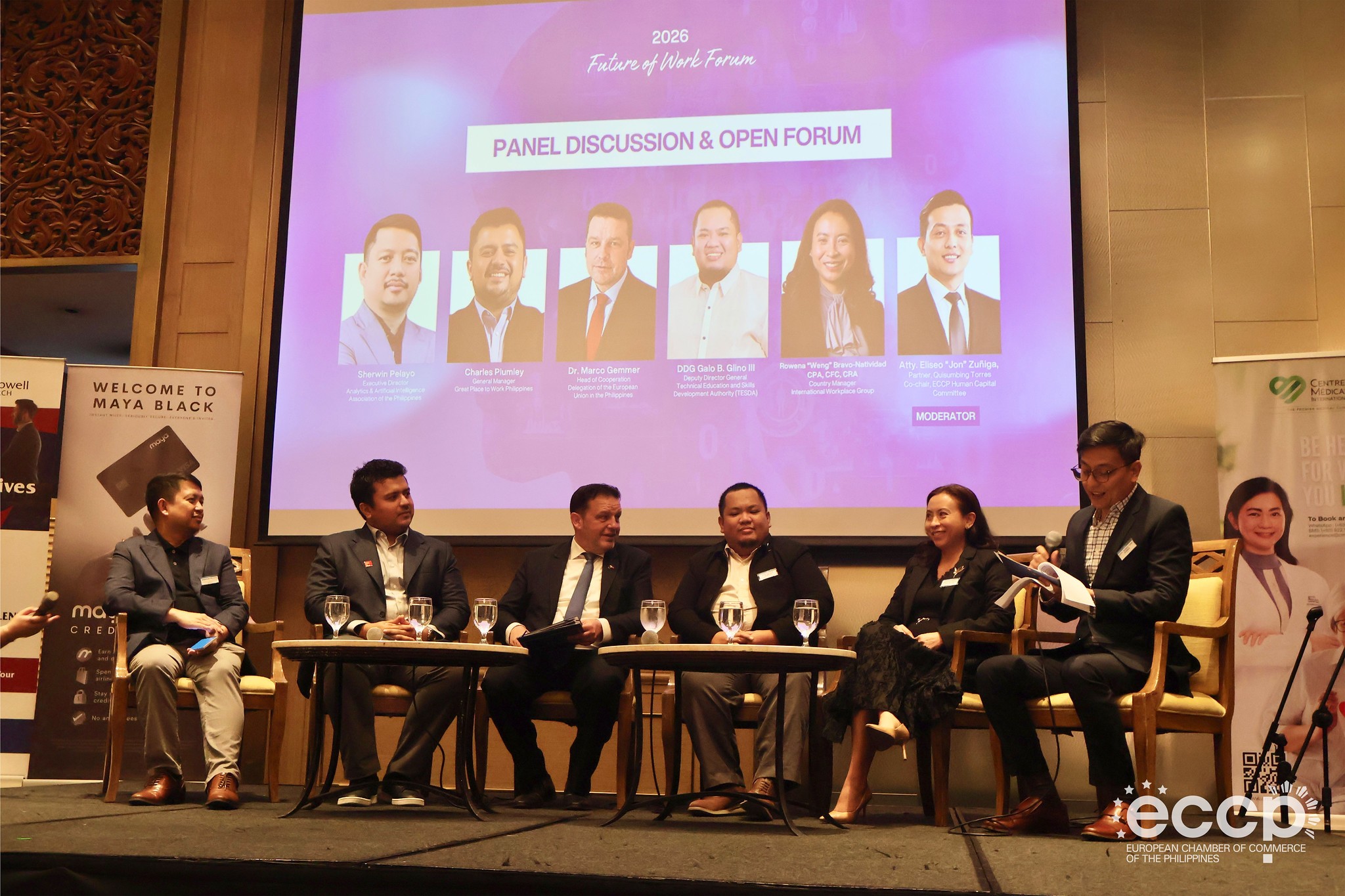
The panel that followed, featuring Dr. Gemmer, DDG Glino, Pelayo, Mr. Charles Plumley of Great Place to Work Philippines, and Ms. Rowena “Weng” Bravo-Natividad of International Workplace Group, turned to workplace culture. Plumley stressed that successful AI adoption starts by involving employees early and building psychological safety for experimentation. Bravo-Natividad added that even as AI enables more flexible and hybrid work arrangements, human connection remains what builds culture, resilience, and purpose.
Jobs are not simply disappearing. They are transforming.
Skills, the second session argued, are economic strategy, not a side project.
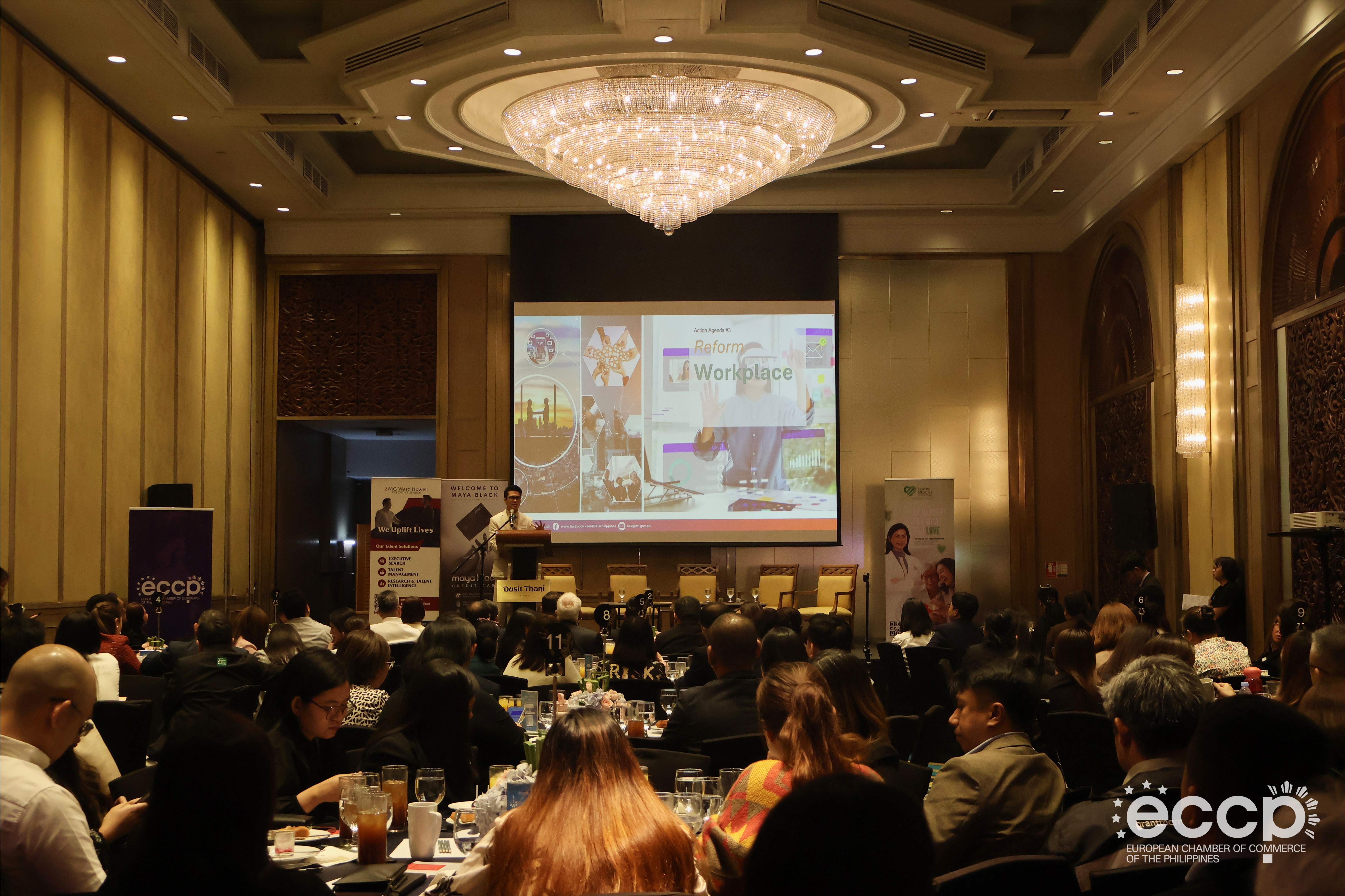
Director Jo-Dann N. Darong of the Department of Trade and Industry (DTI), who is also the World Economic Forum’s Jobs Accelerator Local Coordinator for the Philippines, called for work to be reimagined, the workforce redefined, and workplaces reformed. MSMEs, he noted, should not be expected to become technology companies overnight, but they need support to understand where AI can improve competitiveness.
Mr. Khalid Hassan, Country Director of the International Labour Organization (ILO), brought the data: 12.7 million jobs in the Philippines, concentrated in services, clerical and administrative work, finance, and IT-BPM, have potential exposure to AI. But exposure, he was clear, is not the same as job loss. The real story is transformation. He also flagged that women, who are more heavily represented in clerical, administrative, and service roles, face disproportionate exposure to that shift.
The panel that followed, featuring Darong, Hassan, Ms. Celeste Ilagan of IBPAP, and Mr. Gene A. Gañgan of ZMG Ward Howell, pushed the conversation toward solutions: industry-led micro-credentials, flexible learning, stronger support for MSMEs and workers outside Metro Manila, and the need for companies to move up the value chain.
Building the rules for an AI-ready workforce
The final session turned from opportunity to guardrails.
Atty. Hernan G. Nicdao, Commissioner of the National Labor Relations Commission, walked through how AI intersects with hiring, performance management, and termination disputes. He reminded employers that no matter how technology evolves, labor law, good faith, fair criteria, and proper documentation still apply.
Mr. Christophe Bahuet, Country Representative of the United Nations Development Programme (UNDP), widened the lens. AI policy, he said, is not just a productivity question. It is also a question of whether AI expands people’s choices, capabilities, and opportunities, or deepens inequality within and between countries. He pointed to whole-of-government and whole-of-society approaches as common features of effective AI strategies.
In the closing panel, Mr. Ephraim D. Valenzuela, Chief of the Economic Development Group at the House of Representatives’ Congressional Policy and Budget Research Department, argued for smarter, sector-specific regulation and raised the question of whether some areas may be better served by standards and certification than by rigid legislation.
Mr. Toff Rada, Head of Corporate Affairs at Maya Philippines, Inc., grounded the discussion in practice. He shared how AI is already speeding up identity verification, expanding access to credit, and detecting suspicious transactions in real time. But, he said, Maya is an “AI-first company” and not an “AI-only company,” stressing that AI must be balanced with human expertise and close coordination between the private sector and government.
Rada also pointed to payroll portability as a concrete example of how policy and innovation can improve workers’ financial lives, allowing workers to choose where best to place their money and access financial tools that can help grow their savings.
People, not just technology, will decide what comes next.
Closing the forum, Atty. Eliseo “Jon” Zuñiga, ECCP Human Capital Committee Co-Chair and Partner at Quisumbing Torres, brought the day back to its central idea.
“While artificial intelligence is transforming the way we work, the future of work has never been more about people,” Zuñiga said. “Technology will continue to evolve, jobs will change, new skills will emerge. But our ability to adapt, collaborate, lead with integrity, and invest in people will ultimately determine our success.”
Preparing for that future, he added, is a shared responsibility, requiring enabling policies from government, continuous learning and responsible innovation from businesses, and future-ready skills development from educational institutions.
Through initiatives like the Future of Work Forum, the ECCP reaffirmed its commitment to public-private dialogue that supports responsible AI adoption, workforce transformation, and inclusive growth, strengthening the Philippines’ competitiveness in the digital age.
The ECCP’s 2026 Future of Work Forum is supported by its Embassy Partners: Embassy of Finland in Manila; Industry Partner: Analytics & Artificial Intelligence Association of the Philippines (AAP); Advocacy Leads: Great Place to Work® Philippines and Maya Philippines, Inc.; Advocacy Partner: ZMG Ward Howell; Advocacy Supporter: Regus Management Philippines, Inc.; Table Top Partner: Centre Medicale Internationale; and Media Partners: iMPACT and The Manila Times.



Serving the European-Philippine business community since 1978, the ECCP remains committed to enabling cross-sector collaboration, promoting economic growth, and championing a sustainable future. For inquiries or further information, you may contact us directly or connect with us through our official social media channels.