
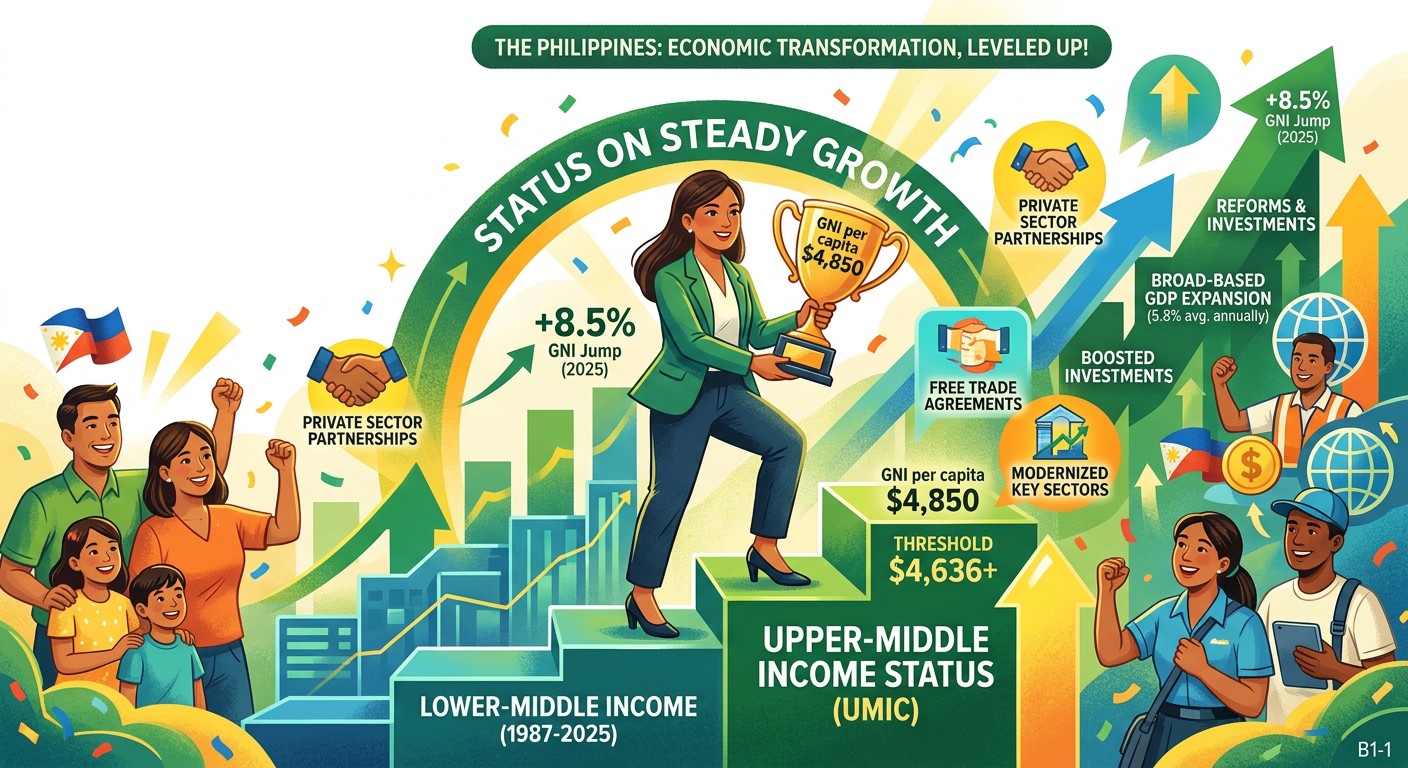
The Philippines has crossed a major economic threshold, earning the upper-middle income country (UMIC) status from the World Bank after nearly four decades in the lower-middle income bracket. The reclassification, following five years of steady GDP growth and a sharp rise in gross national income per capita, marks one of the clearest signals of the country’s economic transformation.
The UMIC status caps 39 years of steady Philippine progress with sustained economic growth and sound macroeconomic management, according to the Department of Economy, Planning and Development (DEPDev).
The World Bank confirmed the upgrade, saying the Philippines’ gross national income (GNI) per capita reached $4,850, above the $4,636 UMIC threshold, after an 8.5-percent jump in 2025.
The Philippines joined Jordan, Micronesia, Sri Lanka and Vietnam in moving from lower-middle to upper-middle income status, while Togo advanced from low to lower-middle income. Other Southeast Asian countries such as Thailand and Indonesia have outpaced the Philippines in the journey to UMIC status, while Malaysia is now at the threshold of becoming a high-income country. Singapore is one of the richest countries in the world.
World Bank economists said in a blog post that the Philippines earned its reclassification through broad-based expansion, with GDP growing an average 5.8 percent annually over five years across all major industries rather than a single sector.
Economic reforms
President Ferdinand Marcos Jr. said the new classification reflects years of economic reform and efforts to make the country more attractive to investors, crediting the government’s push to recognize the private sector as a key development partner alongside efforts to secure more free trade agreements and modernize key sectors. He pledged to sustain reforms to propel growth and boost investor confidence.
DEPDev Secretary Arsenio Balisacan said the reclassification underscores the resilience of the Philippine economy, as the country achieved inclusive growth and strengthened its fundamentals despite global and domestic shocks.
The new classification will strengthen the country’s credit profile, boost investor confidence and open access to financing and higher-quality investments that generate better jobs for Filipinos, Balisacan said. While some concessional official development assistance may decline over time, he said the gains from stronger fundamentals and improved market access will outweigh those adjustments.
Balisacan credited overseas Filipino workers for their contribution to the milestone through remittances that helped lift the country’s GNI, adding that the government’s long-term goal is to create more high-quality jobs at home so overseas employment becomes a choice rather than a necessity.
He said the government remains committed to making growth more inclusive so its benefits reach all Filipinos.
Investment appeal
The European Chamber of Commerce of the Philippines (ECCP) and the American Chamber of Commerce of the Philippines (AmCham) said the upgrade will strengthen the country’s investment appeal.
AmCham said the World Bank’s recognition sends a strong signal to global investors as multinational companies reconfigure supply chains and seek new growth markets across the Indo-Pacific, pointing to the Philippines’ young, skilled and English-proficient workforce, expanding consumer market and long-standing ties with the United States as key draws for advanced manufacturing, digital services, infrastructure and healthcare investment.
The ECCP said the upgrade reflects the country’s sustained growth and reform efforts and strengthens the case for concluding an ambitious EU-Philippines free trade agreement, building on strong Philippine exporter use of the EU’s Generalised Scheme of Preferences Plus.
The milestone comes as the Philippines chairs ASEAN for 2026, giving the country a platform to showcase its economic progress and attract further investment.
The country’s rise to UMIC status is a milestone built on sustained growth, broad-based industrial expansion and consistent economic reform.
While officials acknowledge that income disparities persist and some concessional financing may taper off, the consensus is that the gains outweigh the trade-offs.
The next challenge lies ahead: translating the macroeconomic milestone into broader, more inclusive prosperity for all Filipinos.

Serving the European-Philippine business community since 1978, the ECCP remains committed to enabling cross-sector collaboration, promoting economic growth, and championing a sustainable future. For inquiries or further information, you may contact us directly or connect with us through our official social media channels.