
Artificial intelligence is already finding its way into customer service, finance, logistics, manufacturing, risk management and public services. Yet for many businesses, particularly smaller enterprises, the most difficult questions come before deployment.
Where can AI actually create value? Which solution fits the problem? Is the company's data ready? How much will implementation cost? What risks need to be managed? And how can a business test an idea before committing significant resources?
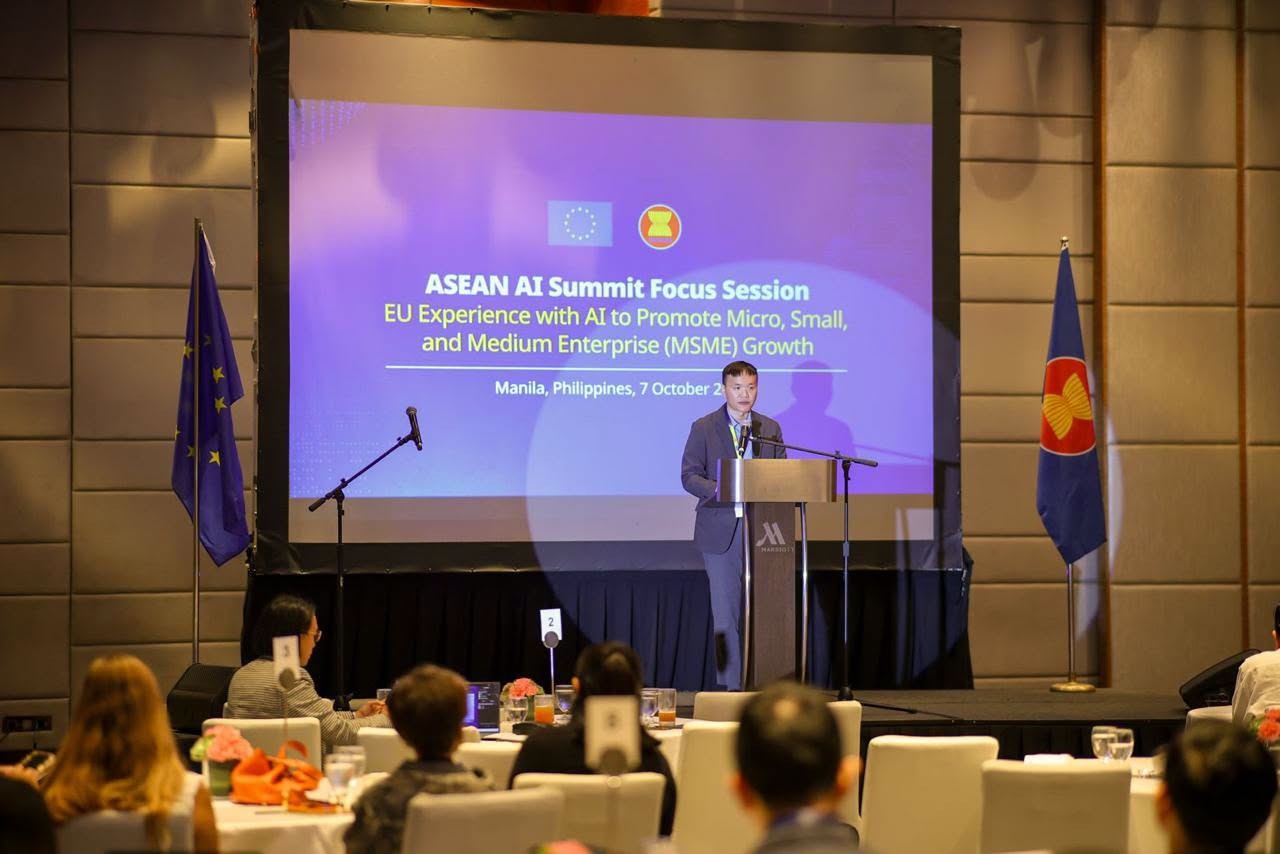
These questions shaped the ASEAN AI Summit Focus Session on “EU Experience with AI to Promote Micro, Small and Medium Enterprise (MSME) Growth,” held in Manila on 7 October 2026. The session brought together Philippine and ASEAN policymakers, European Union representatives, the European AI Office and European technology companies to discuss what makes AI adoption work in practice. The programme included DICT Secretary Henry R. Aguda, DOST Secretary Renato U. Solidum Jr., EU Ambassador to ASEAN Marina Rafti, representatives of the ASEAN Secretariat and Singapore's Infocomm Media Development Authority, officials from the European AI Office, and European digital SMEs.
The cost of an uneven AI transition
DICT Secretary Henry R. Aguda placed MSMEs squarely at the centre of the discussion.
He pointed to the opportunities AI offers businesses, from automating routine work and improving customer service to analysing information more quickly and supporting better decisions. But he also identified the barriers that make adoption difficult for smaller firms: cost, skills, trust and uncertainty over where to begin.
His warning was particularly striking: “If we are not careful, the AI gap could become a growth disparity.”
For MSMEs, the problem is rarely the absence of technology. It is the cost and complexity of figuring out which technology is useful, whether it can be trusted, and whether the expected return justifies the investment.
Aguda ultimately returned the conversation to outcomes.
“The success of AI will not be measured by how advanced the technology becomes. It will be measured by what it makes possible.”
That is a useful benchmark for businesses as well. AI becomes commercially meaningful when it improves an outcome: lower costs, shorter processing times, better forecasting, stronger customer reach or improved productivity.
Technology has to solve something
DOST Secretary Renato U. Solidum Jr. approached the subject through DOST's concept of Agham na Ramdam, science whose benefits can be felt in people's lives.
His examples were concrete: farmers anticipating weather conditions, enterprises gaining tools to expand, and communities responding more effectively to climate risks.
“The true value of AI is unlocked when it translates into everyday solutions,” he said.
Solidum also highlighted the foundations that make those solutions possible: strong institutions, skilled people and high-quality interoperable data. His remarks connected these priorities with broader EU-Philippines cooperation in research, geospatial information, digital governance and trustworthy AI.
For businesses, this points to an often overlooked part of AI adoption. Buying a tool is relatively straightforward. Making it work with existing data, processes, employees and systems is harder.
Europe is placing trust alongside competitiveness
EU Ambassador to ASEAN Marina Rafti situated AI within a wider EU-ASEAN digital partnership.
She described the European approach as a “third way”, seeking to avoid both state-controlled technology and systems developed without adequate safeguards. The objective is to encourage innovation while maintaining the trust and protections necessary for wider adoption.
The European proposition presented at the session also had a clear business dimension. Rafti referred to opportunities involving secure digital networks, digital public infrastructure, digital identity, cybersecurity and AI ecosystems, including partnerships between European and local companies.
She described the EU as seeking to be “a stable and a reliable partner” in the region's digital transformation.
For European companies looking at Southeast Asia, this suggests a potentially important competitive position. In sectors where data, security and compliance matter, trust and interoperability can become part of the commercial value proposition.
ASEAN sees AI as an economic transformation agenda
The regional perspective reinforced the same concern about widening access.
Sivaram Superamanian, Assistant Director of the Digital Economy Division at the ASEAN Secretariat, described AI as an “economic transformation agenda” with consequences for productivity, trade, investment, labour markets, supply chains and competitiveness. He stressed that adoption must extend beyond large companies and major cities to MSMEs, startups, workers and smaller economies across the region.
That framing expands the policy discussion considerably.
If AI is treated only as a technology issue, attention naturally falls on infrastructure, software and regulation. Treating it as an economic issue raises additional questions: Which companies can access the technology? Which sectors gain productivity? Can firms operate across markets? Are cross-border data systems trusted and interoperable? Does the workforce have the skills required to use new tools effectively
Those are questions that will increasingly determine how broadly the economic gains from AI are distributed.
ASEAN is also moving toward practical SME support
Foong Huei Tai of Singapore's Infocomm Media Development Authority, representing Singapore as Chair of the ASEAN Working Group on AI Governance, discussed ASEAN's work on responsible AI, including governance guidance, testing and assurance.
His remarks became especially relevant when he turned to SMEs.
For many businesses, awareness is already high. The challenge is determining where AI adds value, which solutions are appropriate, what capabilities are needed, how data should be prepared and how risks should be managed.
Foong outlined plans for an ASEAN SME AI playbook intended to provide practical guidance at different stages of digital readiness, supported by capacity building, technical assistance and pilot partnerships. EU-AI-summit-focus-sessio-e8395.
This matters because guidance alone rarely changes enterprise behaviour.
A small business may understand that AI could improve operations and still have no clear way to evaluate providers, estimate costs or test whether a proposed solution works.
Europe's adoption infrastructure offers useful lessons
The presentation by Emilia La Nave of the European AI Office offered a practical European comparison.
The EU has spent considerable effort developing its AI regulatory framework, but the discussion in Manila gave significant attention to what helps organisations move toward actual deployment.
Europe's wider AI ecosystem includes computing infrastructure, skills initiatives, testing facilities, regulatory sandboxes and support networks intended to help companies find and adopt appropriate solutions.
One particularly relevant model is the network of European Digital Innovation Hubs.
A core service described during the session was “test before invest.”
The principle is straightforward: an organisation should be able to evaluate a technology, understand its requirements and test its usefulness before committing substantial resources to deployment. The model links technical testing with skills development, financing support and access to wider networks of expertise.
For an MSME, this can substantially reduce the cost of making the wrong technology decision.
It also changes the nature of support. Instead of simply informing a company that AI exists, the business receives help deciding whether a particular application makes sense.
Regulation works better when companies can understand it
The European private-sector speakers brought the discussion closer to what companies experience on the ground.
Regina Cantoni of Yaghma, a member of the European Digital SME Alliance, discussed the difficulties smaller firms face in keeping track of evolving AI regulation, standards and risk requirements.
Her presentation highlighted an important operational problem: governance and compliance issues are often identified relatively late in the development process, when correcting them becomes more difficult and more costly.
The implication is practical. Responsible AI works better when governance is designed into the product or procurement process early rather than treated as a final compliance exercise.
Jeanne Christiansen Gozzer of the European AI Office later explained the EU's risk-based regulatory approach, under which requirements vary according to the risks created by a particular AI application. The European framework seeks to provide common rules across the EU market while distinguishing between different levels and types of risk.
For businesses, regulatory clarity can be almost as important as regulatory intensity. Companies need to know what applies to them, when it applies and what evidence they will need to demonstrate compliance.
What happens after a successful pilot?
Anna Muzalska of Quidgest, also representing a European digital SME, raised another issue that deserves greater attention: the path from experimentation to actual market deployment.
She discussed barriers involving local regulation, interoperability with existing systems, procurement requirements and tender criteria that may be difficult for smaller or newer technology providers to satisfy. She also referred to regulatory sandboxes and the importance of having a clearer route from cross-border pilots toward eventual deployment.
This is a particularly relevant issue for governments and large organisations investing in innovation.
Demonstrating that a technology works is only one step. A successful solution still has to pass through procurement, integration, cybersecurity, governance and budgeting processes before it becomes part of normal operations.
Without that pathway, organisations can accumulate impressive pilots without achieving much change at scale.
What ECCP takes from the discussion
The Philippine, ASEAN and European interventions point in a similar direction.
Businesses need more than access to technology. They need usable data, skills, financing, trusted providers, testing environments and rules they can understand. Smaller companies feel these constraints more sharply because they have less capacity for expensive experimentation.
The discussion therefore points to several areas worth deeper engagement between business and policymakers: AI readiness, practical pathways to adoption, interoperable and trusted digital systems, and the conditions that allow successful applications to move beyond experimentation and scale.
The European experience also raises ideas that merit further examination in the Philippine context, including test-before-invest models and regulatory sandboxes, particularly where they can help enterprises assess new technologies while managing cost and regulatory risk.
These issues closely intersect with the agenda of the ECCP AI Forum on 22 October, which will examine AI through three connected lenses: Governance, Cyber Resilience, and Enterprise at Scale. The Forum's programme covers national AI readiness and high-trust digital ecosystems, AI governance and regulation, critical infrastructure and data protection, as well as real-world AI applications aimed at improving productivity and competitiveness across key sectors.
One practical question from the 7 October discussion is worth carrying into that conversation:
When a business sees a problem that AI might solve, how easy have we made it for that company to test the idea, understand the risks and decide whether it is worth scaling?



Serving the European-Philippine business community since 1978, the ECCP remains committed to enabling cross-sector collaboration, promoting economic growth, and championing a sustainable future. For inquiries or further information, you may contact us directly or connect with us through our official social media channels.